
Front steps in Boston take salt, snow, freeze-thaw, and foot traffic from two or three units. Patching them is tempting. Here is how to decide when patching stops making sense, using a recent Dorchester concrete rebuild as the example.
When a repair is the right call
If the concrete mass is sound and the damage is surface spalling, a chipped nosing, or a railing that has worked loose from its anchors, repair it. Grind and patch the surface, reset the railing in fresh anchors, and seal it. That is a one-day job and it buys years.
When it is time to replace
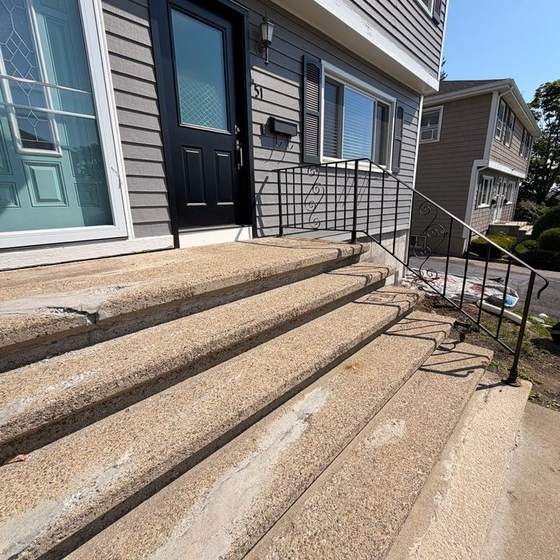
- Cracks that go through the step, not just across the surface
- The steps have pulled away from the house or the landing has dropped, which means the base underneath has moved
- Treads are uneven in height, which is a trip hazard and a code issue
- The set has been patched more than once and the patches are failing again
- The railing moves when you lean on it because there is nothing solid left to anchor to
The Dorchester job
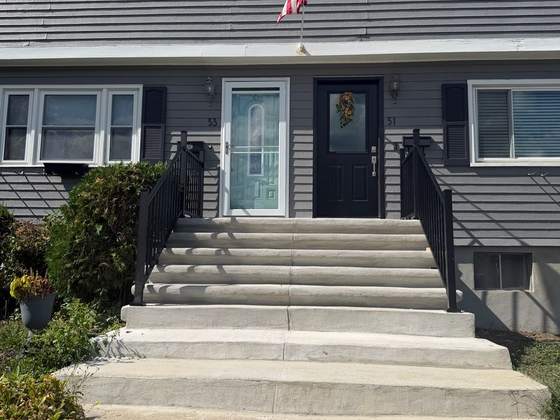
A two-family owner on Boutwell Street had front steps that had been patched twice before we saw them. Each patch had been skimmed over concrete that was already breaking up, so the fix lasted a season. We recommended a full rebuild rather than a third patch: demolish the old set, form and pour new steps with a shared landing across both entries, hand-finish the treads on site, then come back after the cure to install new black aluminum railings on both sides. The railing was a second phase, with materials picked up and delivered from Lowe's and installed over two days at the end of August.
The owner spent more than a patch would have cost. He also will not be paying for steps again for a long time, and his tenants stopped complaining about the wobble.
Poured concrete, precast, or wood?
For a shared entry on a two- or three-family in Boston, poured concrete wins. It handles salt, freeze-thaw, and daily traffic from multiple units, and it does not rot at the bottom the way wood stringers do where they meet grade. Precast steps are faster to set but only as good as the pad under them, and they are hard to fit to an existing landing. Wood makes sense on a single-family with a deck-style entry, as long as the framing is pressure-treated and the fasteners are hot-dipped or stainless.
Railings that stay put
Railings need to be rated for a 200-pound load at the top. On concrete that means core-drilled posts set in anchoring cement after the pour has cured, not surface-mounted brackets on tapcons. Aluminum is our default: no rust, no repainting, and it holds up to the salt.
Permits and code
Replacing a set of exterior steps in Boston, Quincy, and most surrounding towns needs a building permit. Rise and run have to be consistent, railings are required on open sides, and guards are required over a certain height. We pull the permit and build to the inspection, so the work is on record if the property is ever sold.
Call (617) 642-2617 or book a free assessment. We will tell you plainly whether they need a repair or a rebuild.
Call (617) 642-2617